Paper, board, ink
9.5 x 9.5 x 7 in
24.1 x 24.1 x 17.8 cm
2012
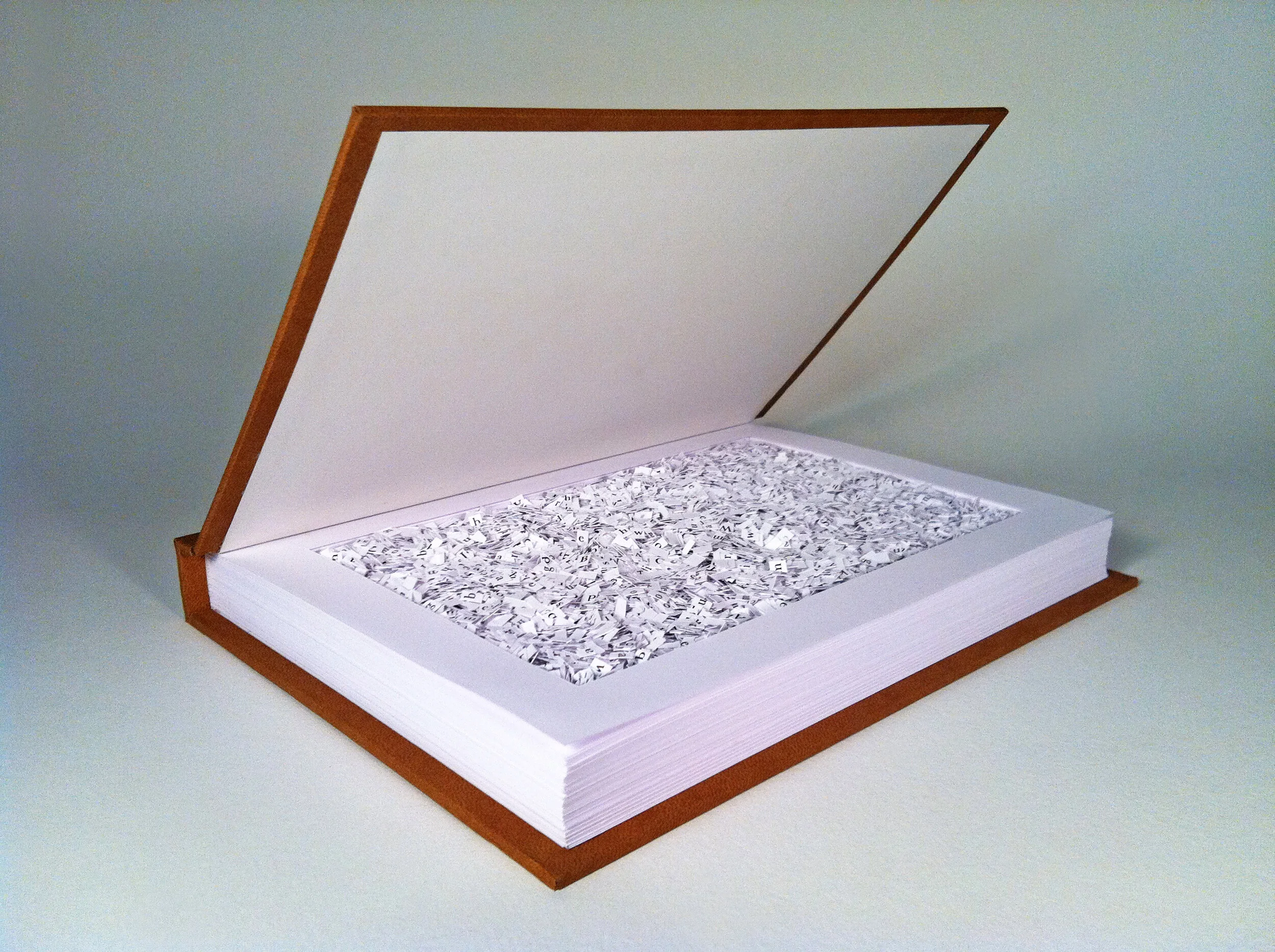
Richard Humann • Finnegan’s Wake • Paper, board, ink • 9.5 x 9.5 x 7 in • 2012
In Finnegans Wake, Richard Humann transforms a portion of James Joyce’s famously complex novel into a sculptural exploration of language, meaning, and literary possibility. Widely regarded as one of the most challenging works in the Western literary canon, Joyce’s Finnegans Wake is celebrated for its experimental language, layered references, invented words, and resistance to conventional interpretation.
For the sculpture, a portion of Joyce’s text has been printed and cut apart, letter by letter. The individual characters are then placed inside a hollowed-out cavity within the pages of a bound volume, transforming the book into a physical repository of the language it once contained. The original text is dismantled, leaving behind the fundamental elements from which its complex narrative was constructed.
The work extends Humann’s exploration of language by using a text already known for pushing the limits of comprehension. Joyce’s writing challenges the stability of words and meanings; Humann takes this process further by physically separating the letters from their original sequence. The text becomes both present and absent: its material components remain, yet its original structure and narrative are no longer accessible.
The sculpture suggests that language consists of a finite collection of elements capable of generating an immense range of meanings. The letters originate from a literary work whose complexity already blurs the boundaries between sense and nonsense, narrative and dream. By dismantling Joyce’s text, Humann turns literary deconstruction into a literal, sculptural gesture.
Finnegans Wake invites viewers to consider what remains of a work when its words are separated from the structure that gives them meaning. The letters become fragments of a literary world, preserving the potential for language while obscuring the narrative they once formed. Humann transforms the book into a container of both lost meaning and unrealized possibility, asking whether a text exists in its physical components, its arrangement, or the act of interpretation itself.
Photo credit: Richard Humann Studio