Milk Teeth
Paper, ink, glass
4.5 x 3 x 2.75 in
11.4 x 7.6 x 6.9 cm
2026
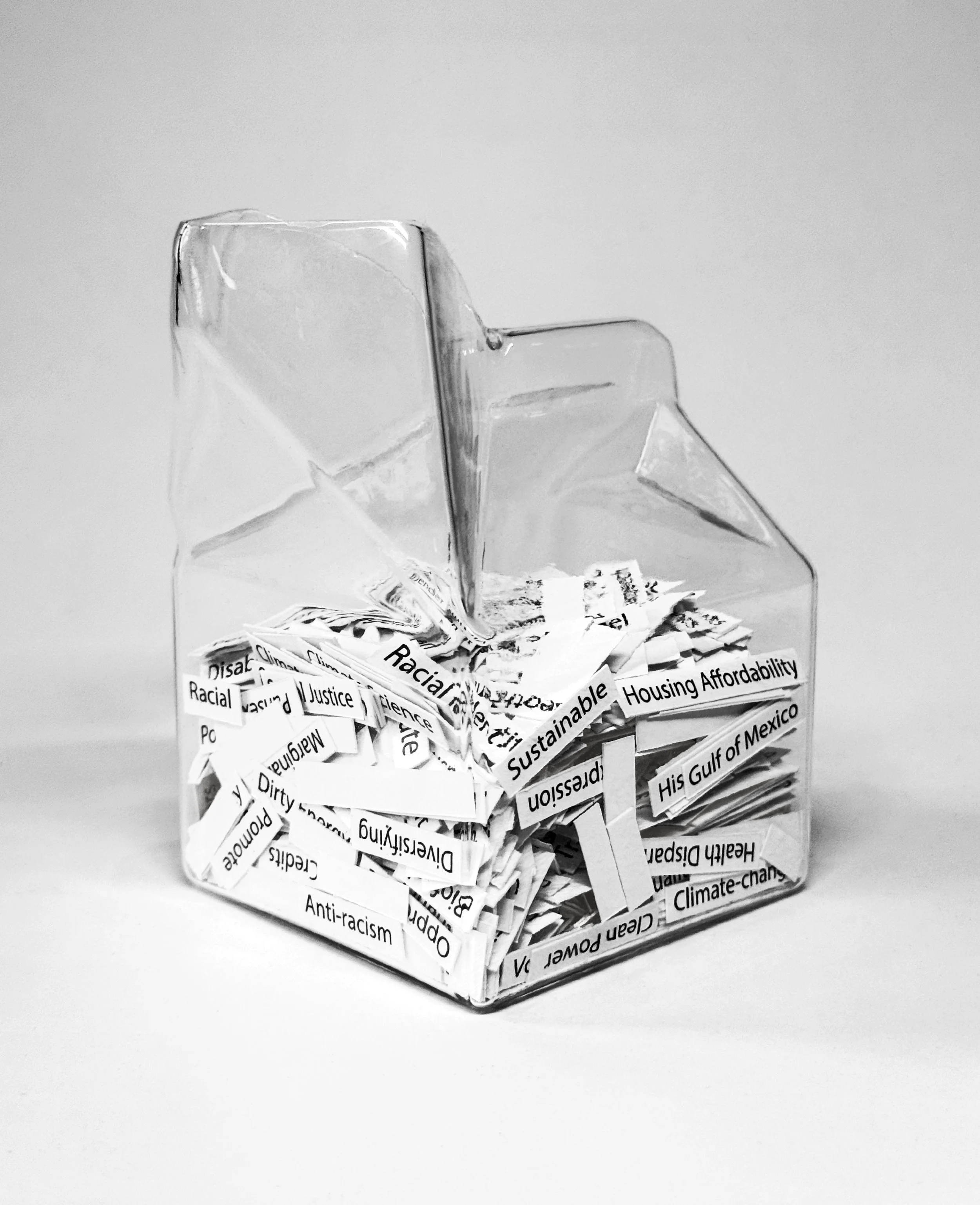
Richard Humann • Milk Teeth • Paper, ink, glass • 4.5 x 3 x 2.75 in
In Milk Teeth, Richard Humann places government-banned words and phrases inside a glass vessel shaped like the half-pint milk carton he drank with lunch every day in elementary school. Printed on acid-free paper and cut into fragments, the prohibited language becomes a physical presence, visible yet contained. By bringing censorship into an object associated with childhood nourishment, Humann connects the suppression of information to the formation of thought and our understanding of the world.
The familiar carton evokes a formative period when children learn language, mathematics, and social studies while also discovering society’s rules and their place within it. Recast in glass, the everyday object becomes a container for restricted knowledge. The fragments remain visible, yet their confinement gives censorship a tangible form. The language has not disappeared; it has been gathered and contained.
The title, Milk Teeth, carries a double meaning. Milk teeth emerge during infancy, when milk is a primary source of nourishment, and their pale color echoes the whiteness of milk. Humann extends this association from physical sustenance to intellectual development. The banned words become a form of mental nourishment—language that feeds curiosity, expands understanding, and makes critical thought possible.
The glass vessel establishes a tension between visibility and access. The words can be seen, but their fragmentation and confinement complicate their reception. This contradiction raises a fundamental question: who determines what we are permitted to know, and how does restricting language shape our understanding?
By joining prohibited language with the memory of a school lunch, Milk Teeth connects censorship to the development of independent thought. The work suggests that suppressing words also limits the ideas people can encounter and consider. What sustains us is not only what we consume, but what we are permitted to think, say, and know.
Photo credit: Richard Humann Studio