Cedar block, paint
6 x 88 x 48 in
15.4 x 223.5 x 121.9 cm
1998
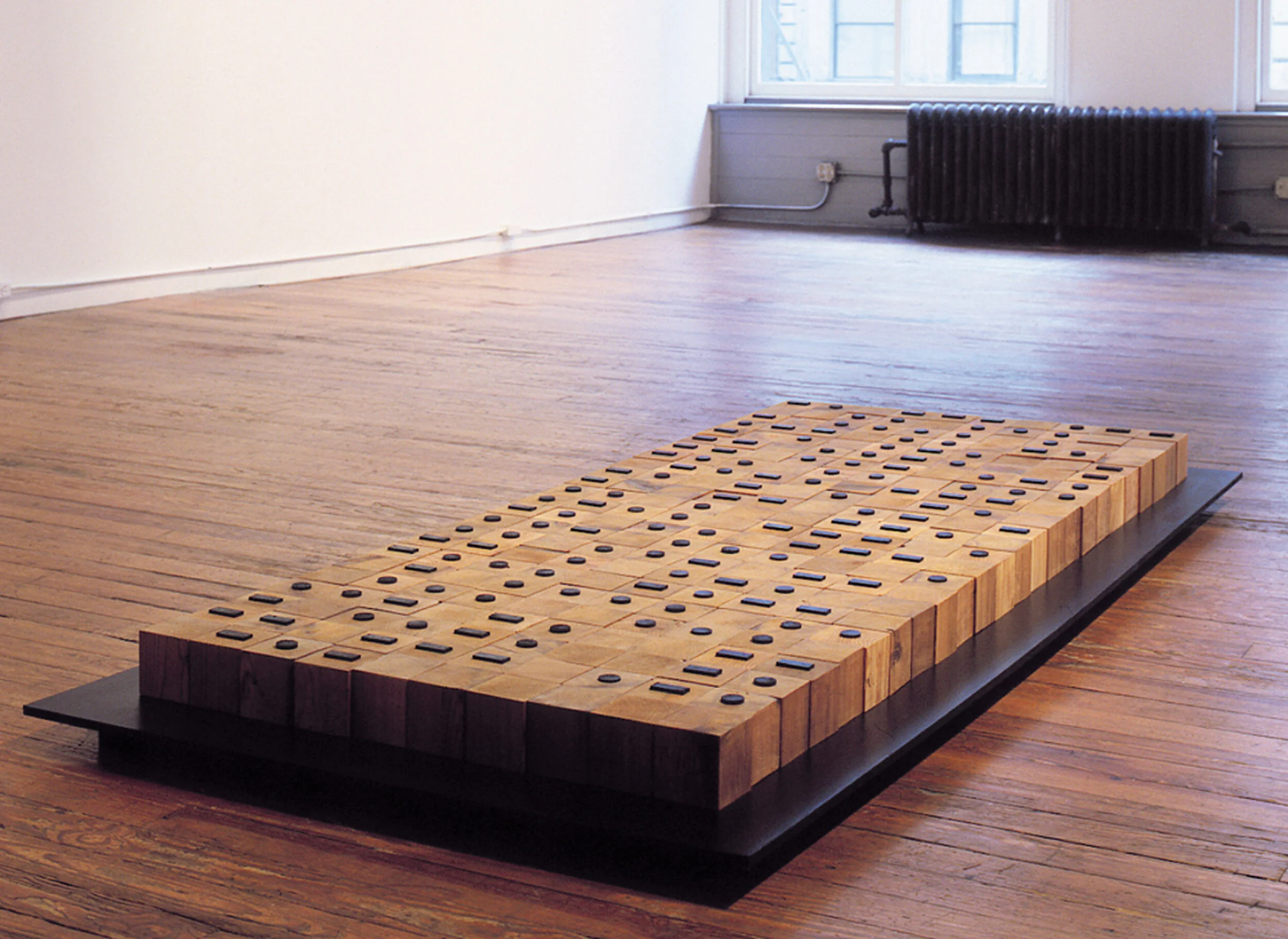
Richard Humann • Richard III • Cedar block, paint • 6 x 88 x 48 in • 1988
In Richard III, Richard Humann transforms a passage from William Shakespeare’s play into a sculptural language of coded symbols. Cedar blocks are cut, sanded, and marked with dots and dashes representing Morse code, translating Shakespeare’s words into a physical sequence arranged across the gallery floor. The passage, “Now is the winter of our discontent / Made glorious summer by this son of York,” becomes a text that can be read, but only through an understanding of the code.
The familiar lines acquire a different presence when translated from language into material form. Words are broken into their constituent signals, with each cedar block carrying a fragment of a larger literary statement. The arrangement preserves the possibility of reading while introducing a barrier between the viewer and the original text. Meaning remains present, but its accessibility depends on the viewer’s ability to decipher it.
The choice of Morse code introduces a system historically associated with transmitting messages across distance through simple signals. Here, dots and dashes replace the written word, turning language into a sequence of discrete units. Cedar, a natural material shaped through cutting and sanding, gives these abstract signals physical weight and permanence. The work brings together the literary, the technological, and the sculptural, asking how meaning changes when it moves between different forms of communication.
Shakespeare’s passage contrasts winter and summer, discontent and triumph, framing political change as a transformation from darkness to renewal. In the sculpture, that statement is itself transformed, becoming a coded message whose meaning must be recovered. Richard III explores the relationship between language and interpretation, revealing how a message can remain intact in one sense while becoming unfamiliar in another. The work makes reading an act of reconstruction, reminding us that meaning is never simply contained in words; it also depends on the systems through which we encounter them.
Photo credits: Joseph Silva / Richard Humann Studio