The Songbird Sings of Home
Ink on styrene, copper, paint
5.5 x 6.5 x 13 in
13.9 x 16.5 x 33.0 cm
2015

Richard Humann • The Songbird Sings of Home • Ink on styrene, copper, paint • 5.5 x 6.5 x 13 in • 2015
In The Songbird Sings of Home, Richard Humann brings together personal histories from around the world to explore the universal human need for home, family, and belonging. The sculpture consists of a series of handwoven bird nests constructed from sentences printed on styrene and cut from stories submitted by individuals reflecting on their childhoods. The contributions arrive in the participants’ native languages, including Arabic, Chinese, Croatian, English, Finnish, German, Italian, Korean, Russian, Spanish, and others. Each story carries the imprint of a particular upbringing, shaped by the language, culture, geography, religion, and family traditions through which a person first encounters the world.
Humann transforms these written accounts into the physical substance of the sculpture. Rather than presenting the stories as conventional texts to be read from beginning to end, he cuts them into individual strips and weaves them together to form nests. Each strip remains legible, preserving a fragment of an individual’s memory, while the complete narrative becomes impossible to reconstruct. The stories are no longer experienced as separate accounts with distinct beginnings and endings. They become interwoven, their individual meanings retained in part but absorbed into a larger, collective structure.
This transformation is central to the work. The act of weaving brings together experiences that may have little in common on the surface, allowing them to coexist within a shared form. The viewer can recognize the presence of many individual voices without fully accessing the lives behind them. Each sentence offers a glimpse into a personal history, while the nest as a whole suggests that no single story can fully define the experience of home. Individual memories become part of a collective expression, demonstrating how personal identity and shared human experience can exist simultaneously.
The choice of the bird’s nest gives this idea a physical and emotional foundation. A nest is constructed from separate materials gathered and arranged to create a place of protection, rest, and nurturing. It is a structure built in response to the need for safety, particularly during the vulnerable stages of life. By using childhood stories as the building material for these nests, Humann draws a parallel between the way birds construct shelter and the way human beings develop their earliest understanding of home through family, relationships, and lived experience. The stories do not merely describe these formative experiences; they become the very material from which the shelters are made.
The nests are suspended from a branch handcrafted from copper, introducing another dimension to the work. The branch recalls the natural environment in which birds build their homes, while its constructed form connects the organic world to the deliberate labor of the artist. The contrast between copper and the woven text emphasizes the meeting of natural instinct and human experience. The nests appear as individual structures, yet their relationship to the same branch connects them, suggesting a larger network of lives rooted in a common need for shelter and belonging.
The diversity of languages is essential to the sculpture’s meaning. Language is one of the earliest ways we learn to understand our families, communities, and place in the world. It carries cultural knowledge, emotional associations, and memories that can be difficult to translate fully into another language. In The Songbird Sings of Home, these differences are not erased or reduced to a single voice. The distinct languages remain visible within the nests, affirming the particular identities of the people who contributed their stories. At the same time, the work proposes that the feelings underlying those stories—comfort, safety, affection, and connection—extend beyond linguistic and cultural boundaries.
By bringing these accounts together, Humann considers what we share despite the many circumstances that distinguish us. People may grow up in different countries, practice different religions, speak different languages, and inherit different cultural traditions. Their memories of childhood will never be identical. Yet the desire to feel protected, to be connected to family, and to find a place in which one belongs is widely recognizable. The sculpture does not claim that our differences are insignificant; instead, it suggests that they need not prevent us from recognizing one another.
The title, The Songbird Sings of Home, evokes the bird’s song as an expression of place and belonging. A song can communicate without requiring a common spoken language, reaching others through sound, rhythm, and feeling. In the context of the sculpture, the individual strips of text function like fragments of a larger composition. Each carries its own voice, but together they form a collective expression that exceeds any single contribution.
Ultimately, The Songbird Sings of Home turns the intimate material of childhood memory into a meditation on our shared humanity. By weaving individual stories into structures associated with shelter and protection, Humann presents home as more than a geographical location or cultural identity. It is an emotional foundation formed through relationships, memories, and the experience of being cared for. The nests hold many voices without requiring them to become one, suggesting that our differences can remain intact while we recognize the fundamental needs that connect us. In this gathering of personal histories, home becomes both deeply individual and universally understood.
Stories by:
Gema Alava, China Blue, Megumi Chen, Mina Cheon, Cristabel Christo, Genevieve Chua, Mohammed El Mourid, Karolyn Sherwood Graham, Jenn Grauer, Heide Hatry, Richard Humann, Christine Koeffler, Päivi Lukkari, Rizwan Mirza, Giacomo Roccon, Ekaterina Shapiro-Obermair, Marissa Soroudi, Robbie Steinbach, Tatyana Stepanova, Barbara Taboni, Katja Villemonteix

Richard Humann • The Songbird Sings of Home • Ink on styrene, copper, paint • 5.5 x 6.5 x 13 in • 2015
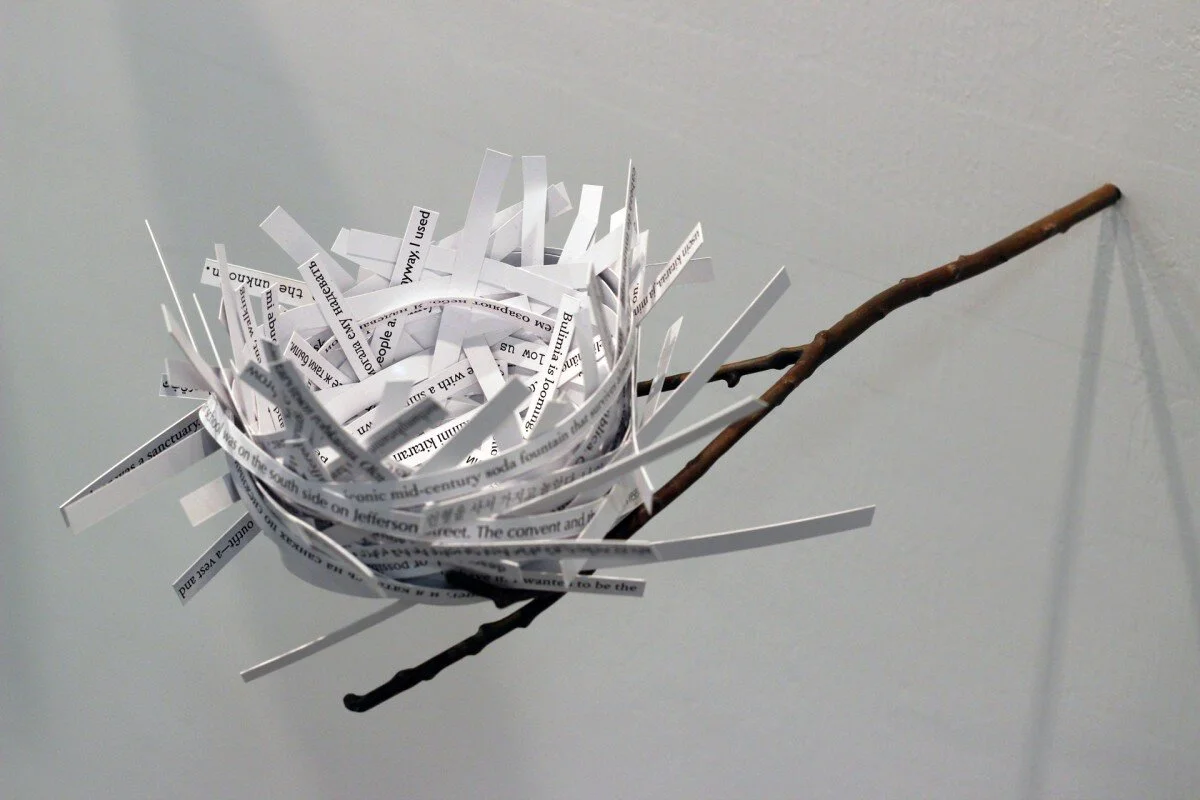
Richard Humann • The Songbird Sings of Home • Ink on styrene, copper, paint • 5.5 x 6.5 x 13 in • 2015
Photo credits: Richard Humann Studio