Basswood, gold paint
20 x 18.75 x 6 in
50.8 x 47.6 x 15.2 cm
2016
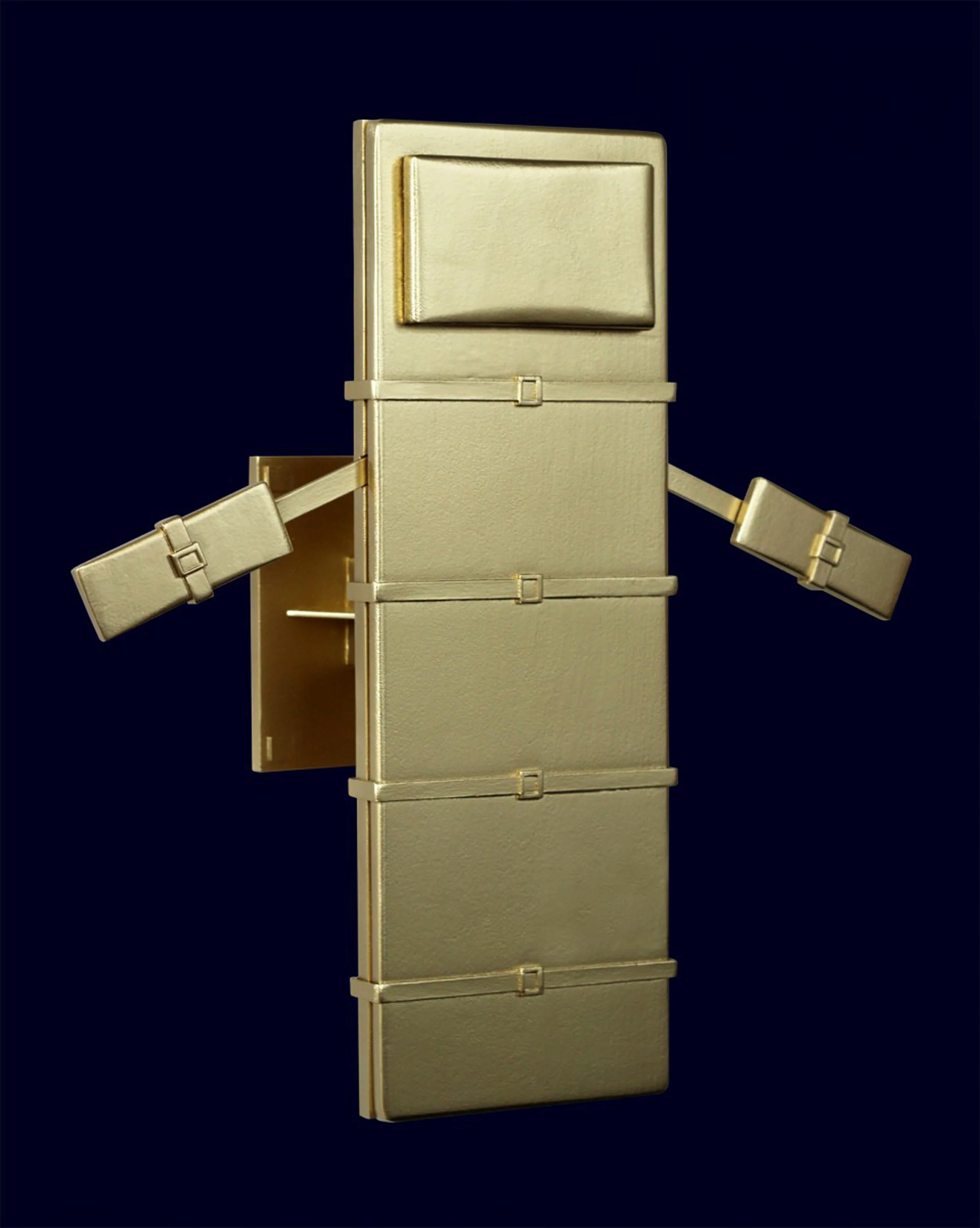
Richard Humann • American Crucifix, Basswood, gold paint, 20 x 18.75 x 6 in, 2016
The comedian Lenny Bruce once suggested that if Jesus had been executed in modern times, Catholic schoolchildren might wear miniature electric chairs around their necks instead of crosses. His observation exposes an unsettling relationship between the instrument of death and the symbol through which a culture remembers it. In American Crucifix, Richard Humann extends this provocation, examining how an act of execution can become sacred history while another remains an instrument of punishment.
The sculpture consists of a lethal injection table finished in gold and mounted on the wall in the manner of a traditional crucifix. Its horizontal and vertical elements evoke the shape of the cross, placing the contemporary apparatus of execution within the visual language of Christianity. The resemblance creates an immediate collision between two objects separated by centuries but connected by their function: both are associated with the deliberate ending of a human life.
The crucifix has become one of the most recognizable symbols in Western culture, its historical instrument of torture transformed into an emblem of sacrifice, salvation, and redemption. Humann’s gold-plated execution table raises a question about this transformation. How does an instrument of death acquire the status of a sacred object? And what separates a death remembered as divine sacrifice from one administered by the state as punishment? By presenting the lethal injection table as an icon, the work challenges the assumption that the meanings assigned to death are universal or self-evident.
Gold intensifies the contradiction. Its associations with wealth, authority, and religious veneration elevate the table beyond its utilitarian function, giving it the appearance of an object worthy of contemplation or devotion. Yet the material cannot conceal what the object represents. The polished surface creates a tension between beauty and brutality, reverence and violence, forcing the viewer to confront the difference between an object’s appearance and its purpose.
The work also addresses the distance between the public symbolism of execution and its contemporary reality. Modern executions take place behind institutional walls, removed from the spectacle that once accompanied public punishment. By mounting the table in the familiar format of a religious icon, Humann brings this concealed instrument into view. The work asks what happens when an apparatus of state power is presented with the visual authority traditionally reserved for sacred objects.
American Crucifix is not simply a comparison between Christianity and capital punishment. It examines how societies construct meaning around death, elevating certain deaths into symbols of sacrifice while treating others as the conclusion of a legal process. Through the collision of religious iconography, political authority, and decorative form, Humann exposes the contradictions embedded in these systems of meaning. The result is an object that resembles something to be revered but demands, instead, to be questioned.
Photo credit: Richard Humann Studio