Stainless steel, speaker, digital audio
96 x 21 x 17 in
243.8 x 53.3 x 43.2 cm
2022
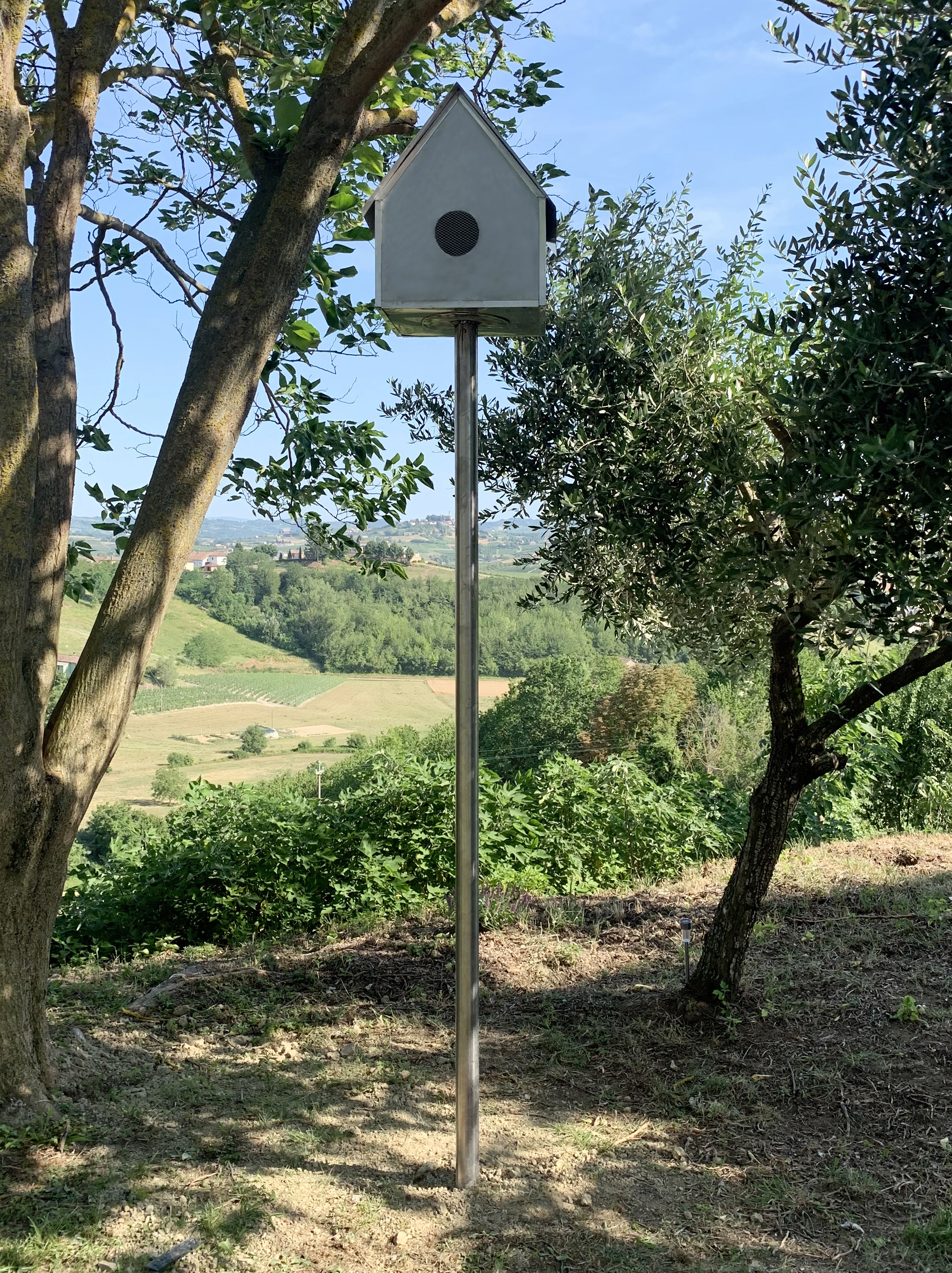
Richard Humann • Subirdia at Casa Bianca Sculpture Park, Castelnuovo Calcea, Piedmont, Italy • 2022
“I am a cage, in search of a bird.”
— Franz Kafka
In Subirdia, Richard Humann draws a parallel between the behavior of birds and the social rituals of suburban life. Birds construct nests to provide shelter and protection, then use calls and displays to attract mates. Human beings, too, build homes that serve both practical and symbolic purposes. Beyond offering security, the suburban home becomes a visible expression of identity, aspiration, and social position—a carefully assembled environment through which its occupants communicate their desirability to others.
The work takes the form of a simplified metal birdhouse, a recognizable structure reduced to its essential outline. Its directness is deliberate. Rather than recreating a birdhouse in naturalistic detail, Humann presents it as a sign: an object that connects the instinct to build a home with the impulse to display it. The sculpture establishes the central analogy of the work, positioning the home as both a place of refuge and a site of performance.
The sound is central to the work’s conceptual structure. Humann recorded the ordinary noises of domestic life—cabinets opening and closing, kitchen appliances operating, and other household activities—and edited these recordings into sequences that resemble birdsong. The resulting calls occupy an ambiguous territory between the natural and the manufactured. They are abstract enough to suggest the irregular rhythms of birds, yet retain traces of the familiar sounds from which they were constructed. Recognition emerges gradually, never entirely displacing the initial impression of birdsong.
This uncertainty is essential to the work. The listener moves between hearing a call and recognizing the activity of a household, between the apparent language of courtship and the sounds of everyday living. Through this shift in perception, Humann transforms domestic routine into a performance of attraction. The home seems to announce itself through a language that is at once instinctive and culturally constructed, as though the accumulated objects and activities of suburban life have developed their own form of birdsong. The sound does not merely illustrate the comparison between birds and human beings; it enacts that comparison, allowing the familiar environment of the home to be heard as a display designed to attract attention.
Beneath the humor of this transformation lies a pointed observation about wealth, possession, and social status. A home communicates through its architecture, furnishings, appliances, and other signs of material success. These possessions may serve practical needs, but they also operate as signals, projecting an image of the people who own them. In Subirdia, such displays begin to resemble the calls and gestures through which birds establish their presence and attract potential mates. The work suggests that the suburban home can function as an elaborate courtship ritual, with material accumulation serving as a form of advertisement.
Yet Humann’s comparison does not simply reduce human behavior to biological instinct. The work instead reveals how seemingly natural desires—security, attraction, belonging—become entangled with cultural expectations and economic values. What begins as the basic need for shelter expands into a system of display in which the home signifies far more than the act of living within it. The boundary between necessity and performance becomes difficult to locate.
The title Subirdia, combining suburbia with the avian world, gives this relationship a name. It proposes a hybrid environment in which the conventions of suburban life can be viewed from an unfamiliar perspective. By translating domestic sounds into bird calls, Humann makes the ordinary seem strange enough to be reconsidered. The home, usually experienced as a private and familiar space, becomes a public signal—a structure that speaks on behalf of its inhabitants.
Through this modest sculpture and its disquieting soundtrack, Subirdia asks what people are communicating when they build, furnish, and display their homes. The answer is neither entirely conscious nor entirely voluntary. Like birdsong, the signals of domestic status may be so deeply embedded in everyday behavior that they go largely unexamined. Humann’s work makes those signals audible, exposing the courtship ritual concealed within the routines of suburban life.
Collection at Casa Bianca Sculpture Park, Castelnuovo Calcea, Asti Provence, Piedmont, Italy.
Photo credit: Richard Humann Studio